
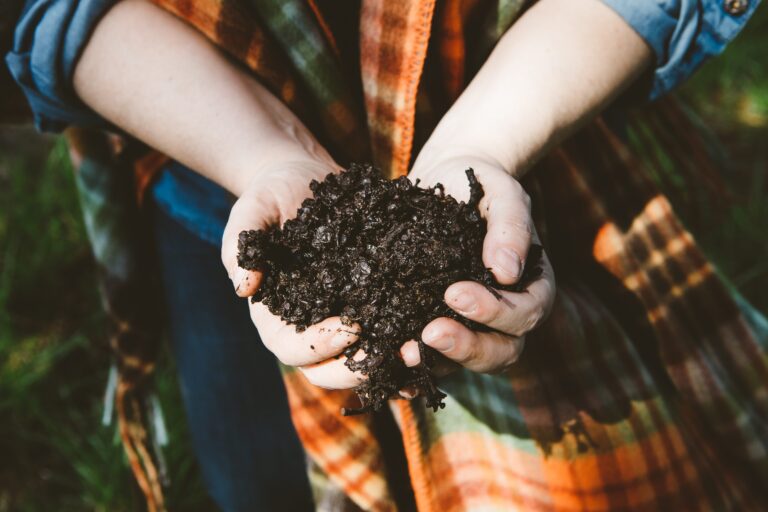
Biodynamics, Explained: Compost Isn’t Just Fertilizer
Think of compost as a living community—and the biodynamic preparations as the small but mighty crew that helps it work.
When most people hear compost, they think fertilizer. Something you spread on the ground to feed a plant.
In biodynamics, we think about it a little differently.
We aren’t just trying to feed the vine. We’re trying to feed the soil that feeds the vine.
Healthy soil is alive with fungi, bacteria, microorganisms, worms and roots, all interacting beneath our feet. Compost helps support that living community by returning organic matter and nutrients to the land.
And on our farm, some of that compost begins with the grapes themselves.
From Vineyard to Winery—and Back Again
After harvest, grapes travel from the vineyard to the winery. Once they’re pressed, we’re left with grape pomace—the skins, seeds and stems.
But we don’t think of that as waste.
We combine it with manure and other plant material to make compost. Eventually, that finished compost makes its way back to the vineyard.
The vineyard feeds the winery. The winery feeds the vineyard.
It’s a beautifully simple circle.
But biodynamics adds one more interesting ingredient to the compost pile: the preparations.
Meet the Compost Crew
Six biodynamic compost preparations are made from yarrow, chamomile, stinging nettle, oak bark, dandelion and valerian.
They’re used in surprisingly small quantities. Think of them less like ingredients in a recipe and more like the crew helping everything in the kitchen work together.
Each has its own job.
Yarrow: The Nutrient Traffic Director
Yarrow is associated with potassium and sulfur and is used to help regulate how nutrients become available within the soil. Think of it like a traffic director—not adding more cars to the road, but helping everything get where it needs to go.
Chamomile: The Nitrogen Keeper
Nitrogen is incredibly important to plant growth, but it can also be easily lost. Chamomile is traditionally used to help stabilize nitrogen during composting. Think of it as the pantry manager, helping us hold onto something valuable rather than letting it disappear.
Stinging Nettle: The Balancer
Associated with nitrogen and iron, nettle is used to encourage biological activity and balanced nutrient cycling. Think of it as the compost’s coach—helping the whole team work better together rather than focusing on one player.
Oak Bark: The Foundation Builder
Oak bark is naturally rich in calcium and is traditionally associated with balance and resilience. Think of calcium like part of the framing of a house: it helps provide the structure that everything else depends upon.
Dandelion: The Connector
Dandelion is associated with silica and potassium and the relationships between nutrients in the soil. Think of it as the matchmaker—helping create connections so nutrients aren’t simply present, but can become useful within the larger system.
Valerian: The Spark
Valerian is associated with phosphorus and warmth. Phosphorus plays an important role in root development and how plants transfer and store energy. Think of valerian as the spark that helps keep the engine moving.
None of these preparations is a fertilizer in the traditional sense.
They’re more like tiny conductors in a very large orchestra—intended to help all the biological activity already happening in the compost work together.
The Compost Pile Is Only the Beginning
Here’s an important distinction: the preparations aren’t simply about making better compost.
The ultimate destination is the soil.
Once that finished compost is spread through the vineyard, it returns organic matter and nutrients to the land while supporting the environment where roots, microorganisms, fungi and other soil life interact.
And biodynamic preparations don’t end at the compost pile.
Some are applied directly to the vineyard. Horn Manure (Preparation 500) is sprayed onto the soil and is traditionally used to support soil life, humus formation and root development. Horn Silica (Preparation 501) is sprayed over the vines and is associated with light, photosynthesis and ripening.
We’ll get to those wonderfully strange-sounding horns next.
Closing the Loop
Biodynamics can sound complicated—and occasionally a little bizarre—when you encounter the individual practices without understanding the larger idea behind them.
But compost gets right to the heart of it.
Take what the farm gives you. Transform it. Return it. Build life instead of continually extracting from it.
Every harvest removes something from our vineyards. Compost allows us to return something.
Grape skins become compost. Compost becomes soil. Soil supports roots. Roots support vines. Vines grow grapes.
And we begin again.
That’s why compost isn’t just fertilizer.
It’s one of the ways a farm learns to feed itself.
Next in Biodynamics, Explained: Why We Put Cow Manure in a Horn.