
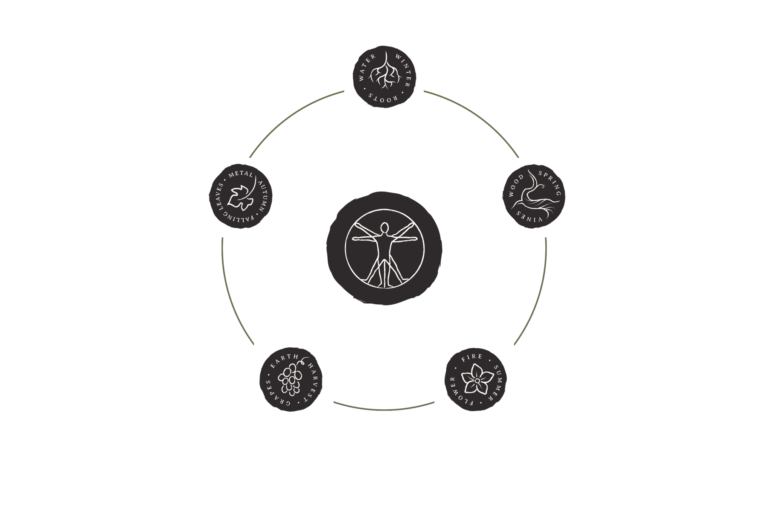
The Five Elements—Wood, Fire, Earth, Metal and Water—come from ancient Chinese philosophy. Although commonly called elements, the Chinese term *Wu Xing* is more accurately translated as the “Five Phases” or “Five Movements.”
Each describes a form of movement found in nature:
Wood expands and grows.
Fire rises and radiates.
Earth nourishes and transforms.
Metal contracts and refines.
Water stores and restores.
Together, they describe the continuous movement of a living system through growth, maturity, transformation, release and renewal. Nothing exists in isolation, and nothing remains in one state forever.
The Five Elements and Acupuncture
Five Element theory is one of several frameworks used in traditional Chinese medicine and acupuncture. It helps practitioners understand relationships among the body’s organs, functions, emotions, senses, seasons and patterns of change.
Rather than looking only at the location of a symptom, an acupuncturist may look for a larger imbalance. What is feeding the symptom? What is failing to regulate it? Where has the natural movement of the system become blocked?
The goal is balance.
Balance does not mean that everything remains equal or unchanging. It means each part of the system can perform its role without overwhelming the whole.
Bringing Eastern and Western Ideas Together
This philosophy deeply influenced our founder, Dr. Robert Gross.
Robert was trained as a Western physician. He later returned to school to study acupuncture and homeopathy, intending to bring Eastern and Western approaches to medicine together.
He did not see these traditions as interchangeable. Each had its own history, methods and language. But both helped him explore the same question:
What does it mean for a living organism to be healthy?
Western medicine taught him to observe, diagnose and treat. Eastern medicine encouraged him to look for patterns, relationships and balance throughout the whole organism.
When Robert turned his attention to farming, he brought this perspective with him.
From the Body to the Vineyard
Biodynamic agriculture emerged in Europe and belongs to a Western agricultural tradition. It is not derived from Five Element theory or Chinese medicine.
Yet biodynamics also asks us to understand the farm as a living organism—a system of soil, plants, animals, water, weather, microorganisms and people.
This was the philosophical connection for Robert.
Five Element theory gave him an Eastern framework for understanding balance and movement. Biodynamics gave him a Western agricultural framework for applying a similar whole-system perspective to the land.
He was not combining them into a single farming practice. He was bringing the same question to both:
How do we help a living system become healthy enough to maintain its own balance?
The Five Elements in the Vineyard
Although the Five Elements are not part of biodynamic agriculture, their seasonal cycle offers a beautiful way to understand the vineyard.
Water: Winter and the Roots
Water represents winter, rest, storage and renewal. The vines may appear dormant, but their roots remain connected to the soil while winter rain replenishes the land. Energy is conserved for the growing season ahead.
Wood: Spring and the Vine
Wood belongs to spring, growth and expansion. Sap begins to move, buds open and shoots reach outward. Wood is present in the vine’s trunk and canes, as well as in its impulse to grow.
Fire: Summer, Flowers and Canopy
Fire represents summer, warmth and full expression. The canopy expands, flowers bloom and fruit begins to form. Sunlight provides energy, while careful farming maintains the balance between heat, shade, foliage and fruit.
Earth: Grapes and Harvest
Earth represents nourishment, transformation and ripening. The vine gathers the energy of the soil, water, roots, leaves and sunlight and transforms it into grapes. At harvest, the fruit enters the cellar and the pomace eventually returns to the compost.
Metal: Autumn and Release
Metal belongs to autumn, contraction and letting go. Leaves change color and fall as the vine draws its energy inward. What is no longer needed returns to the soil, preparing the vineyard for winter.
A Living Cycle
Water becomes Wood. Wood feeds Fire. Fire returns to Earth. Earth produces Metal. Metal leads us back to Water.
Five Element theory and biodynamic agriculture come from different cultures and traditions. They are not the same practice. But in Robert Gross’s life, they became complementary ways of understanding health.
The body is a living system. The farm is a living system. Neither can be truly healthy if we treat its parts as though they exist alone.
For us, wellness is balance—in our bodies, our soils, our vines and the systems that sustain them. That is what Robert brought from healing people to healing the land: the belief that true health begins when we understand and care for the whole.