
What Is a Biodynamic Flow Form?
One of the first things visitors see at Cooper Mountain Vineyards is our flow form, surrounded by a garden of plants used in biodynamic preparations.
But what exactly is it?
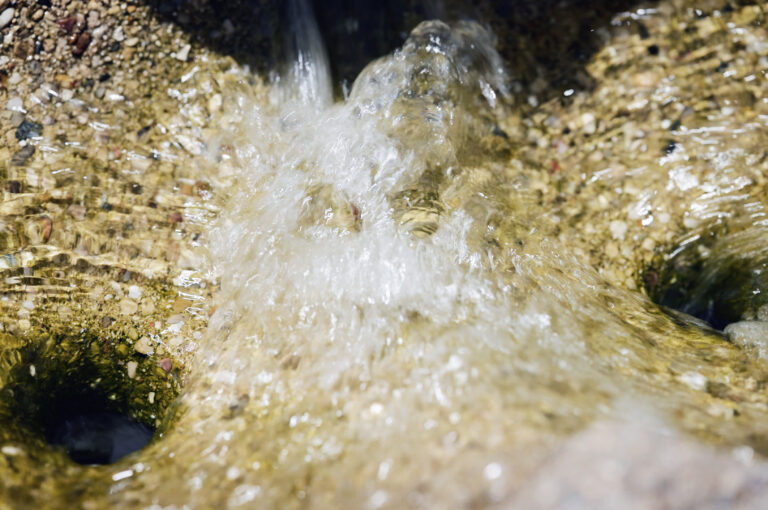
A flow form is a series of sculpted basins that sends water through a repeating figure-eight pattern, creating alternating vortices as it moves. At Cooper Mountain, we use it to prepare—or dynamize—our biodynamic sprays before they are applied to the vineyard.
Movement With a Purpose
As water travels through the flow form, it continually circulates, tumbles and interacts with air. This movement thoroughly distributes the biodynamic preparation throughout the water while increasing aeration.
Within biodynamic farming, the repeated creation and breaking of these vortices is also understood to activate the preparation before it returns to the vineyard.
The philosophy takes its cue from nature. Streams curve, tumble over rocks and form eddies rather than moving in perfectly straight lines. The flow form recreates some of those natural patterns.
The Idea of Living Water
Movement changes the physical environment of water. Turbulence increases interaction between water and air, encourages gas exchange and keeps dissolved and suspended materials circulating.
This is particularly important to us because that water is ultimately being returned to living soil, home to roots, fungi, bacteria and countless other organisms.
In biodynamics, this relationship between water, movement and life is often described as living water.
Inspired by Nature
Flow forms were developed in the early 1970s by English sculptor John Wilkes, whose work with mathematician George Adams and water researcher Theodor Schwenk explored the rhythmic patterns found in naturally moving water.
Today, flow forms are used in biodynamic agriculture and other ecological applications around the world.
At Cooper Mountain, ours represents something central to how we farm: observe nature, work with its patterns and return life to the soil.