
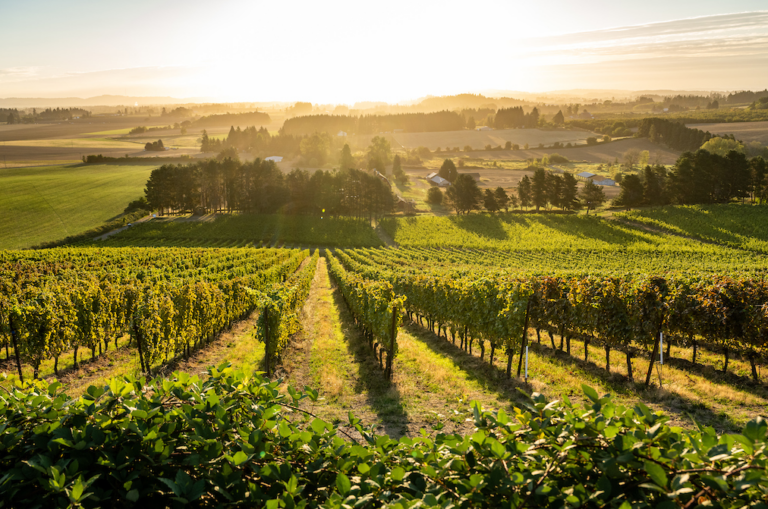
In biodynamic farming, what we do matters. So does when we do it.
A vineyard is never static.
Morning brings cool air, dew and rising light. Afternoon brings heat and evaporation. Evening brings falling temperatures and increasing humidity. Across the year, the vine moves through an even larger cycle—from winter dormancy to spring growth, summer fruit development and fall harvest.
Biodynamics asks us to farm with those rhythms in mind.
Following the Rhythm of the Day
Plants respond constantly to their environment. Sunlight drives photosynthesis. Temperature and humidity affect water use. Soil biology responds to moisture and warmth.
That’s one reason timing plays such an important role in how we use our biodynamic preparations.
Preparation 500, Horn Manure, is applied toward evening. It’s directed toward the soil and roots, when temperatures are cooling and evaporation is slowing.
Preparation 501, Horn Silica, is applied in the morning. It’s misted over the canopy and associated in biodynamic practice with light, leaves and ripening.
One follows the vineyard toward darkness.
The other follows it toward light.
Farming With the Seasons
The same idea extends across the year.
Preparation 500 spends winter underground, during the vineyard’s dormant season. Preparation 501 is buried during the warmer months, when the vineyard is actively growing above ground.
These opposing cycles—winter and summer, darkness and light, roots and canopy—are fundamental to the way biodynamics views the farm.
Rather than treating the vineyard as something that operates the same way every day of the year, we pay attention to where it is in its natural cycle.
What About the Moon?
Yes, biodynamic farmers pay attention to lunar rhythms, too.
Biodynamic calendars divide periods into root, leaf, flower and fruit days, which may be considered when deciding when to plant, prune, cultivate, spray or harvest.
But the calendar doesn’t run the vineyard.
The vine gets a vote. So does the weather. And so does the soil.
If fruit is ready or rain is coming, we don’t ignore what’s happening in front of us because a calendar says otherwise.
For us, the biodynamic calendar is another tool for observation—not a substitute for experience.
Earthly and Cosmic Forces
Biodynamics also uses language about earthly and cosmic forces, an idea that comes from Rudolf Steiner’s original agricultural lectures.
Some of the rhythms surrounding a vineyard are easy to observe and measure: day and night, seasons, sunlight, temperature, moisture and gravity. Biodynamic philosophy considers these alongside broader lunar and cosmic rhythms.
At the center of it all is a simple idea:
The vineyard doesn’t exist separately from the natural world around it.
It is continually responding to light, water, temperature, soil and season.
Our job is to pay attention.
The Vineyard Tells Us When
No two vintages unfold exactly the same way.
Spring might arrive early. Summer may be unusually cool. Rain can change a harvest plan overnight. The calendar may give us a rhythm to consider, but the vineyard tells us what is actually happening.
That’s perhaps the most practical lesson behind biodynamic timing.
It’s not about blindly following a schedule.
It’s about observing more closely.
Because good farming isn’t only knowing what to do.
It’s knowing when to do it.